Send the best artwork you have, ideally vector, plus the finished size, patch type, border, backing, colors and quantity. Then keep small details simple enough to read at that size.
By ProGFX1 · Updated November 21, 2026 · 5 min read
Detail depends on size. A design that looks great at 4 in may lose fine lines at 2 in. For embroidered patches, keep lettering at least about 0.25 in (6 mm) tall as a rule of thumb. If your logo has very small text, consider a woven patch or simplifying the design.
Simple shapes such as circles, ovals, squares and shields usually get a merrowed border, the thick wrapped edge you see on many uniform patches. Custom shapes usually get a cut edge that follows the outline of the design.
Common options are sew-on, iron-on, hook-and-loop (often called Velcro) and adhesive. Sew-on is the most permanent. Hook-and-loop is popular for uniforms and tactical gear because the patch can be swapped.
Vector files (AI, EPS, SVG or PDF) are ideal. If you only have a JPG, PNG, scan or clear photo, send it anyway. ProGFX1 includes artwork preparation with patch orders, and our vector art service can redraw low-quality logos by hand. Learn why in auto-trace vs hand-drawn vector art.
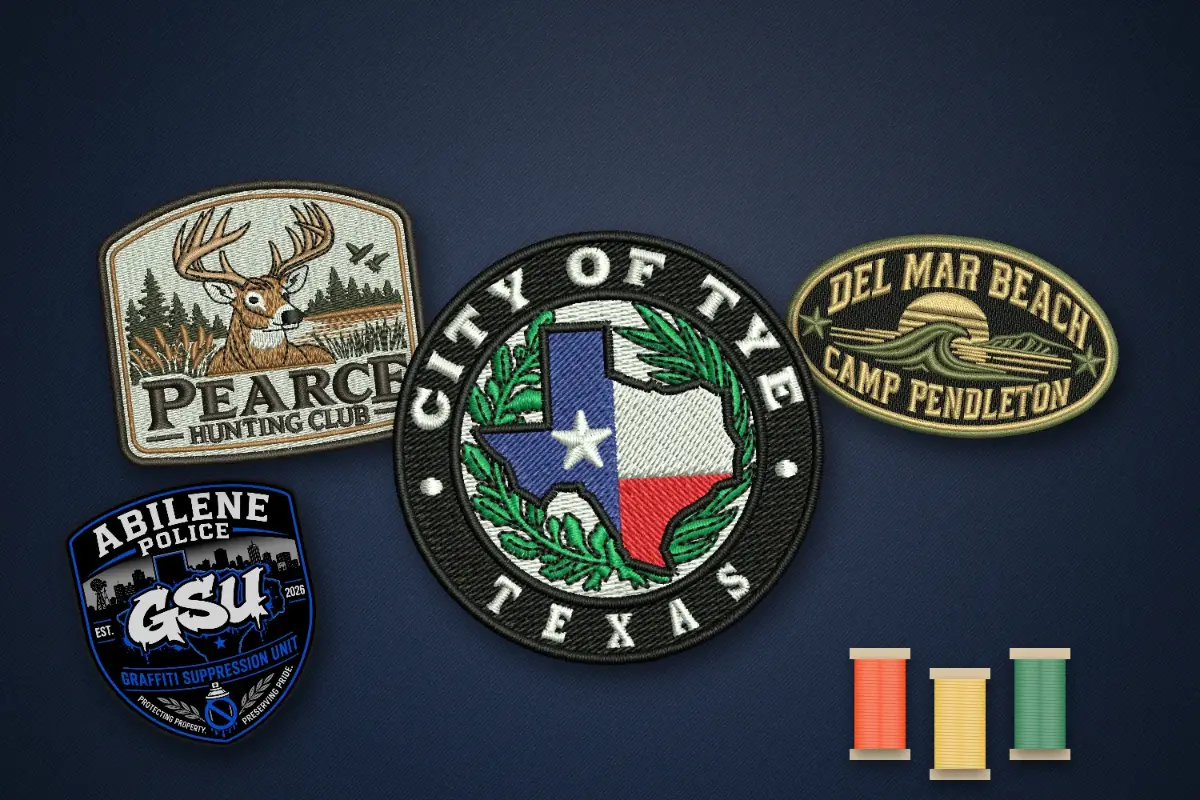
Before production we send a proof so you can check size, colors, spelling and layout. Production starts only after you approve it. Small variations in color and stitching are normal in finished patches.
See our custom patches page for patch types and examples, or request a quote with your artwork and the details above. Patches are priced by size, type and quantity.
A vector file (AI, EPS, SVG or PDF) is best. A high-resolution JPG, PNG or a clear scan also works, because artwork preparation is included.
Embroidered patches have raised thread and suit bold designs. Woven patches use finer thread woven tightly, so they show small text and fine detail better.
By size, patch type and quantity. You receive a quote and a proof before production starts.
Send one logo and see the quality before you choose anything.